
Introducing Witan
TopoLift is a layer that makes any model reason through the lens of your business. Witan grades every answer and every handoff, agent to agent and agent to person, and exposes the moment it deviates. Every answer. Every time.
The problem every enterprise has met
AI writes fluent answers. Nobody can say afterwards which sentence rested on your data and which one did not, and nobody keeps a record that would let them find out.
An answer with no account of its evidence cannot be checked, only trusted.
No record, no review queue, no policy. Regulators and boards are starting to ask for all three.
Stuffing the context with everything burns tokens and still misses the fact that mattered.
The paradigm shift
TopoLift sits between your models and your business. Whichever model you choose, small and local or a frontier API, it has to reason through your records, your rules and your outcomes, not through whatever it absorbed from the internet. Witan watches every exchange, agent to agent and agent to person, and exposes the moment one drifts from that lens.
Witan · Live fidelity
How faithfully your agents are communicating, with each other and with your people, and the moment one of them starts to deviate.
What Witan does
What the model was asked, what it said, what it rests on, a verdict under a written policy, and a tamper-evident link to the record before it.
Excellent, Good, Fair or Poor, under standards you set.
Each record is sealed to the one before it. Change one and the ledger says so.
Poor answers, and any answer that quotes too many numbers not in your data or reverses a conclusion, queue for a person. Accept and sign, or return with a note. Both are in the record.
The policy is versioned. Change it and every past record is read under the new version. The original verdict and its policy stay sealed in the record.
A witan was the council that counselled the king. This one counsels the enterprise.
Three records
Real records from the live demo, on synthetic data sets in two industries.
Example 1 · A construction portfolio of 40 bids
The answer was exact: 40 of 40 bids exclude permit-related scopes. It named the two risks the data ties to that, Permitting Risk and Permit Approval Delay Risk, and recommended three actions. Every sentence pointed at your data.
Good, not Excellent: one sentence read a mitigating fact as a risk. Witan caught it; a reader would have missed it.
Example 2 · 7,000 hospital security incidents
The answer: 9 of 7,000 incidents, listed by number. No estimate, no “around a dozen”.
Answered in under a minute on a single local GPU. The 7,000 records never left the building.
Same engine, a different industry, a data set 175 times larger.
Example 3 · The one that matters most
The answer read well. Every sentence pointed at something real in the data. A human reviewer would have signed it.
Witan did not. The answer linked two things that never occur together in the records, and quoted 13 numbers that are not in the data. Verdict: Poor. Queued for a person.
Fluent, grounded, and wrong in a way no reader could see. This is what governance is for.
Inside a record
What in your data the answer used, and anything it said that the data does not support.
The answer exactly as the person saw it, with the model named. No summary, no paraphrase.
Which sentences are backed, which are not, and which recommend an action.
Export the ledger, verify it has not been altered, and hand it to an auditor.
Nothing in the record is a model's opinion of itself.
The policy
Your risk committee decides what Excellent, Good, Fair and Poor mean, and what goes to a person. Witan applies it to every answer, the same way, at any hour.
A regulator asks “how do you govern your AI?” and the answer is a document, a version number and a ledger you can verify.
A formal audit · One person, one session, 70 questions
Verdicts
Excellent 7 · Good 13 · Fair 35 · Poor 14. Most answers stayed on topic. Where they fell short was quoting numbers and drawing links the data does not support, exactly what a reader cannot see.
Read under the rules now in force: Excellent 46 · Good 15 · Fair 4 · Poor 4. Same 69 records, same answers. Policy v1 counted figures Witan itself had shown the model as “not in the data”, and graded the model’s hidden reasoning as part of the answer. The current rules judge figures against everything shown and grade only the answer, and they add a stricter rule: a case named outside the computed set is Poor. The v1 verdicts stay in every record.
Checked against the truth on a separate test set of 58 questions with computable answers (2026-10-23): the one wrong answer was held; 0 escaped; 4 of 47 right answers were held for review.
Dates, costs, officer names, weather. Six were declined honestly and graded Excellent or Good; two were answered anyway and caught as Poor.
Audit session of 2026-10-21, synthetic incident records, graded under policy v1. 70 questions asked, 69 records written; one question was refused before it reached the model and left no record.
Where it becomes decisive · Agents talking to agents
An agent that directs other agents acts on their answers without a person in between. One unbacked claim at step two becomes the premise of step five. With Witan, every handoff carries a grade the next agent can read before it acts.
Reads each verdict, not just each text.
Hands back the answer, the record and the grade.
Anything below Good is returned, re-asked, or sent to a person. Routing is a rule, not a hope.
Agent-to-agent governance · A recorded run
Agents check each other’s work through the ledger before they act. Here is what happened in a real run when a person stepped in.
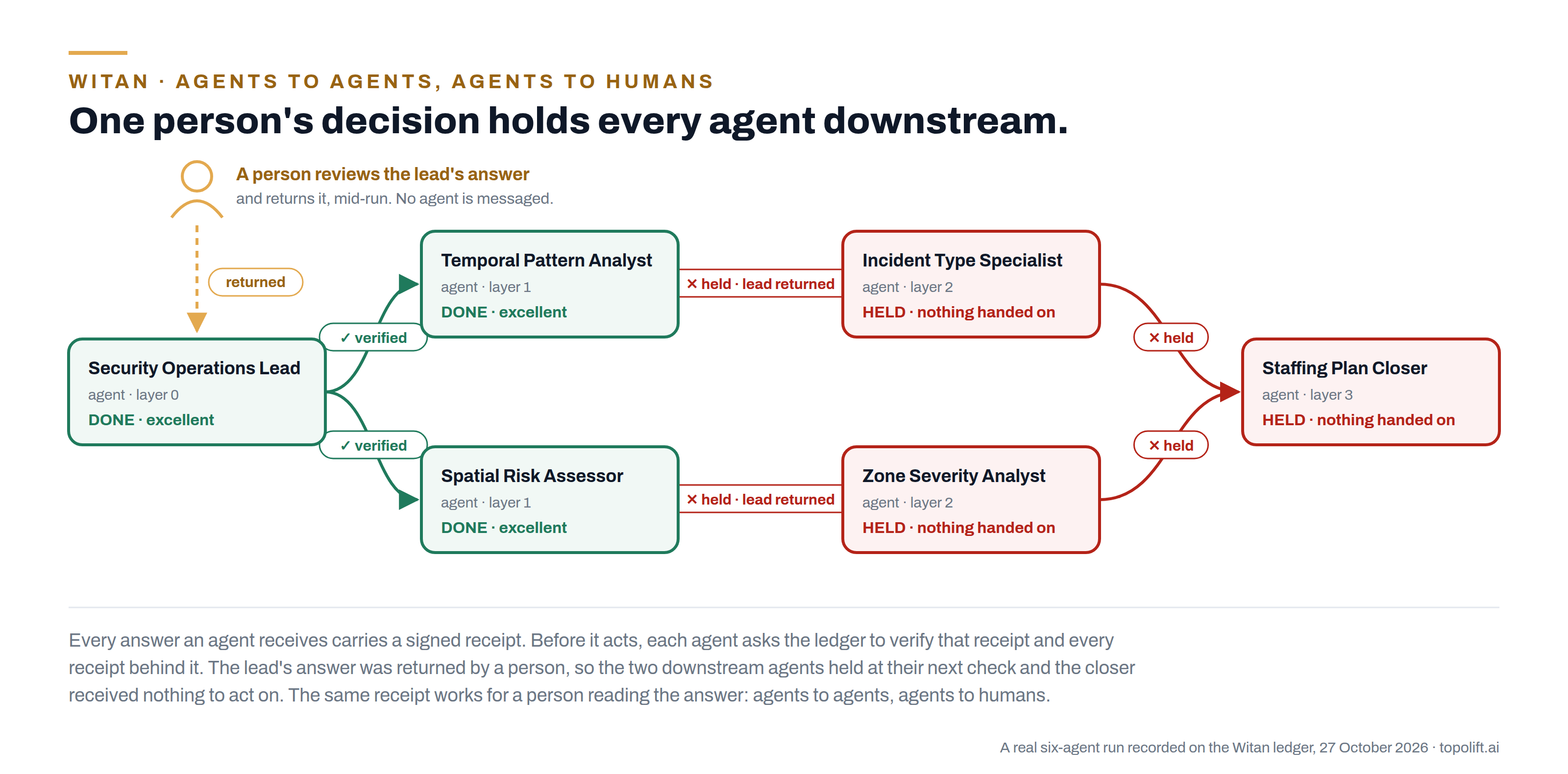
Six agents, one ledger, recorded 27 October 2026. The two layer-1 agents had already verified the lead’s receipt and finished; everything after them held.
Where it fits
Today the whole demo runs on one desktop GPU. Nothing is sent to an outside service.
A small local model, or a frontier API when you choose. The grading and the record are the same.
Bids, incidents, claims, trials, files.
Hospitals, insurers, construction, finance: anyone who must show how an AI answer was reached.
TopoLift asks the data. Witan keeps the record. Together they are the trust and governance layer for enterprise AI.
See the live demo: two data sets, every answer graded, a ledger you can verify. Then bring us your records, and your agents.